
Deus Ex Urbana outdoors
The places in this exhibition exist. The Donjon, the town hall, the municipal greenhouse, Parc Pierre, a street of houses, a car park near the station: thirteen of the nineteen images I am showing were photographed in Sainte-Geneviève-des-Bois. You have probably already walked past them.
From September 2026 and for nine months, the “Deus Ex Urbana” series moves outdoors, into three of the town’s parks: twenty 149 × 99 cm panels — nineteen images and one introduction panel — travelling together, as a complete sequence, from one park to the next.
Where and when
| Place | Address | Period |
|---|---|---|
| Parc Pablo Neruda | avenue Gabriel Péri (near the station) | September → late November 2026 |
| Parc Pierre | rue Léo Lagrange | December 2026 → late February 2027 |
| La Boêle | rue de la Boële | March → late May 2027 |
Free entry, outdoors, during park opening hours. The exhibition is part of the Sainte-Geneviève-des-Bois Heritage Days programme, 18–20 September 2026, at Parc Pablo Neruda. Produced by the town of Sainte-Geneviève-des-Bois and its cultural service. The exhibition was first shown at Espace Brel in February 2026 — this open-air chapter is its continuation.
The premise
Nothing is shown at the moment of disaster. The water has already risen, the sand has already settled in, the air conditioners are already bolted on. Catastrophe has become ordinary here, and it is from that habit that the unease comes.
The images read in groups of three — that is the key, and it is deliberate: the parks offer no guaranteed route, anyone can enter from any end.
I — Cataclysm: it is happening.
II — Adaptation and ingenuity: it has stabilised, people make do.
III — A future without human traces: time has stopped.
The method
Every image starts from a photograph I took on site, in native 3:2. Always. That is the non-negotiable starting point. Then comes a constrained transformation using generative AI tools: the protocol first lists what is preserved, and only then what is substituted. The architecture, the perspective, the geometry of the place are locked. The process does not build a set: it installs a climate in a real place, leaving the architecture intact. An enlargement, then a colour grade of the whole series in a single tool, so that the nineteen images hold together.
Three things I learned making these images, because they are counter-intuitive:
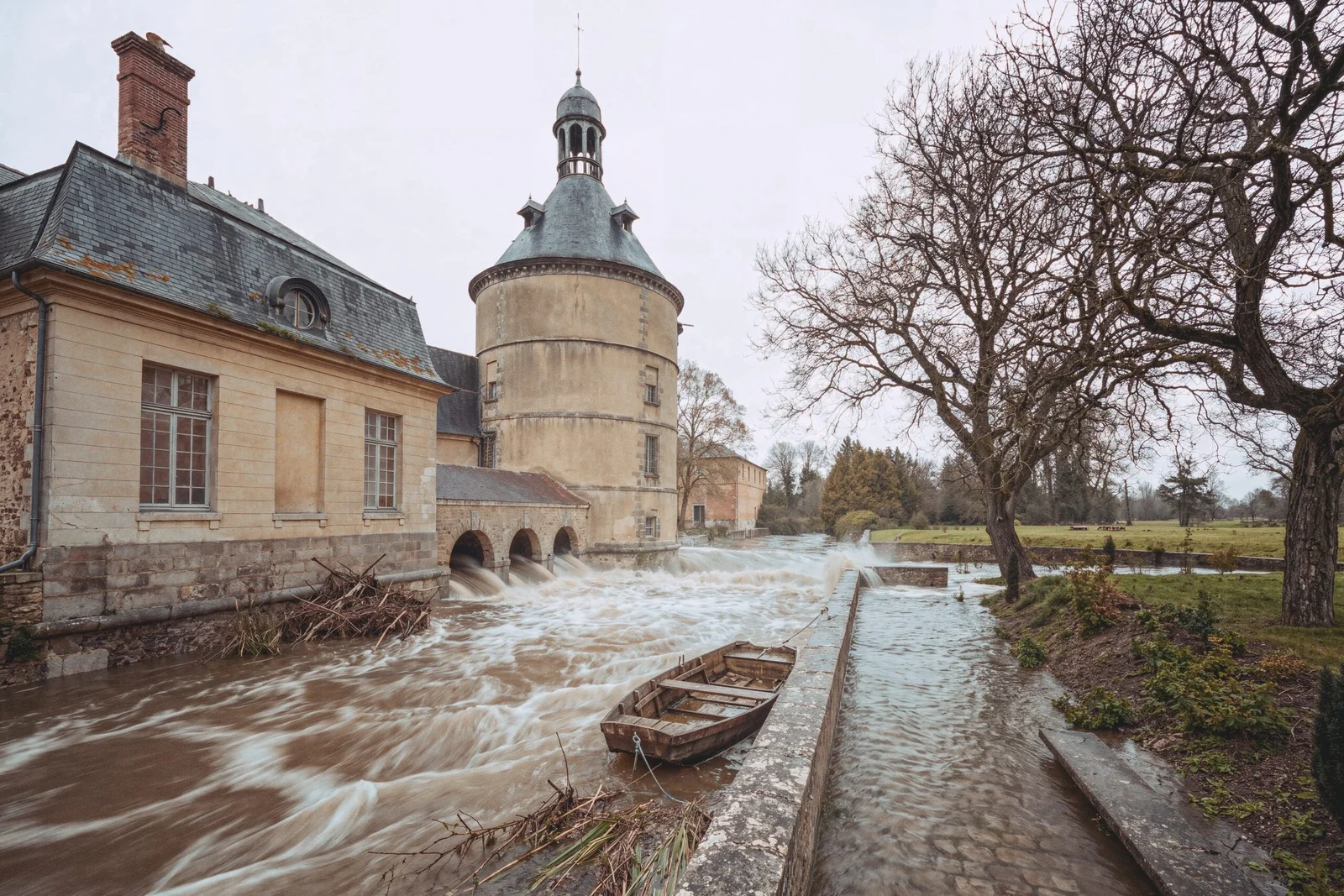
Load causes drift. Beyond three transformations requested at once, the engine stops modifying the image: it regenerates it. On La crue du Donjon, a single transformation was requested and the architecture did not move by a pixel. On La rue aux cigognes, seven transformations were requested — and the street was reinvented.
Cloning is not adapting. An early version of L’empilement produced a stack of identical châteaux — beautiful, but one that nobody had built. Any operation a machine can do on its own — duplicate, mirror — never reads as human adaptation.
What dates the scene changes its meaning. One version of Le convoi showed freshly sawn stumps, sawdust on the ground: it looked like felling in progress, not a forest being replanted. The stumps had to be aged for the image to say what it needed to say.
The nineteen panels
In hanging order.
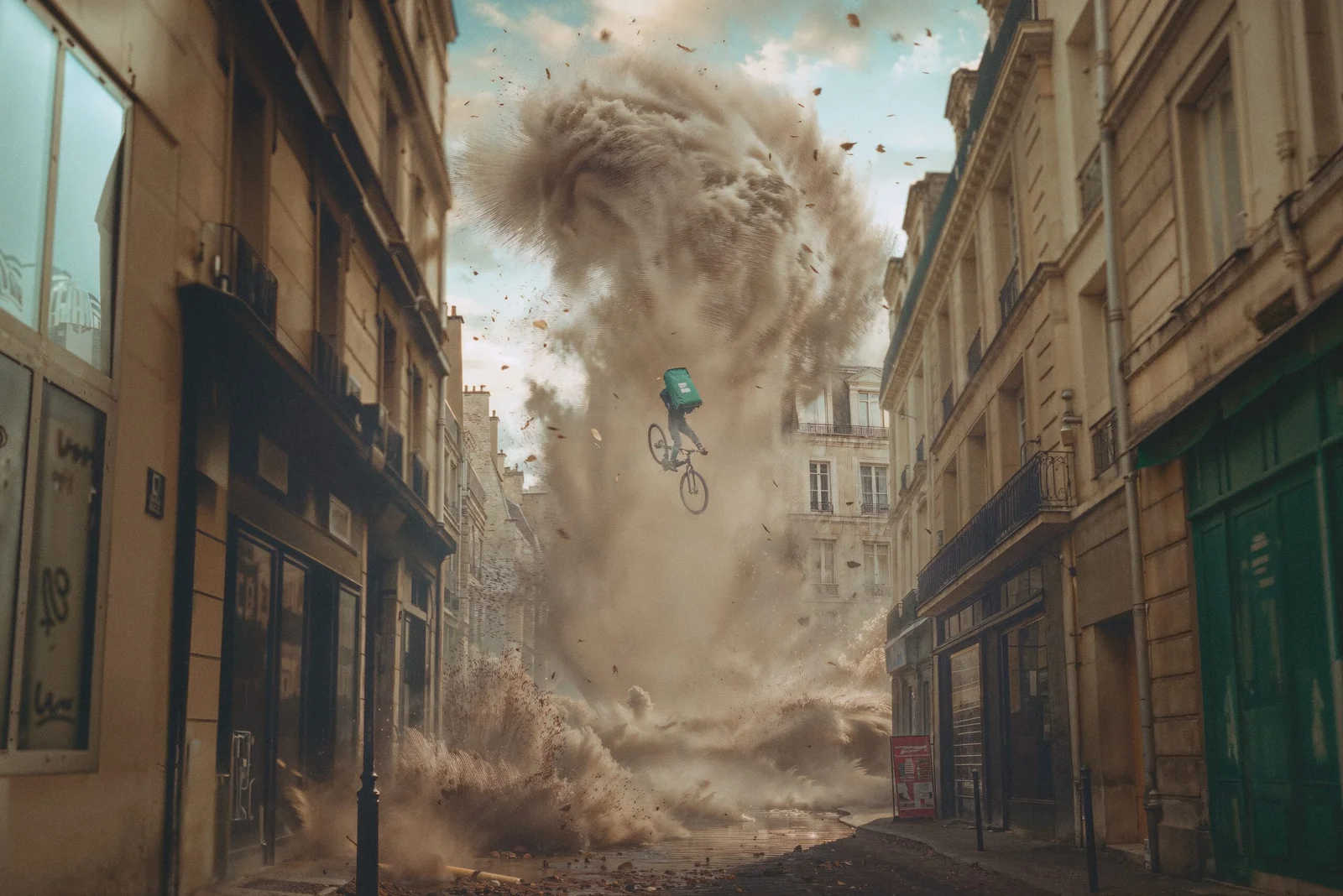
A tornado of sand and rubble sweeps up a deserted street. A bicycle courier, green bag on his back, is carried away at the centre of the vortex. Blue sky above.
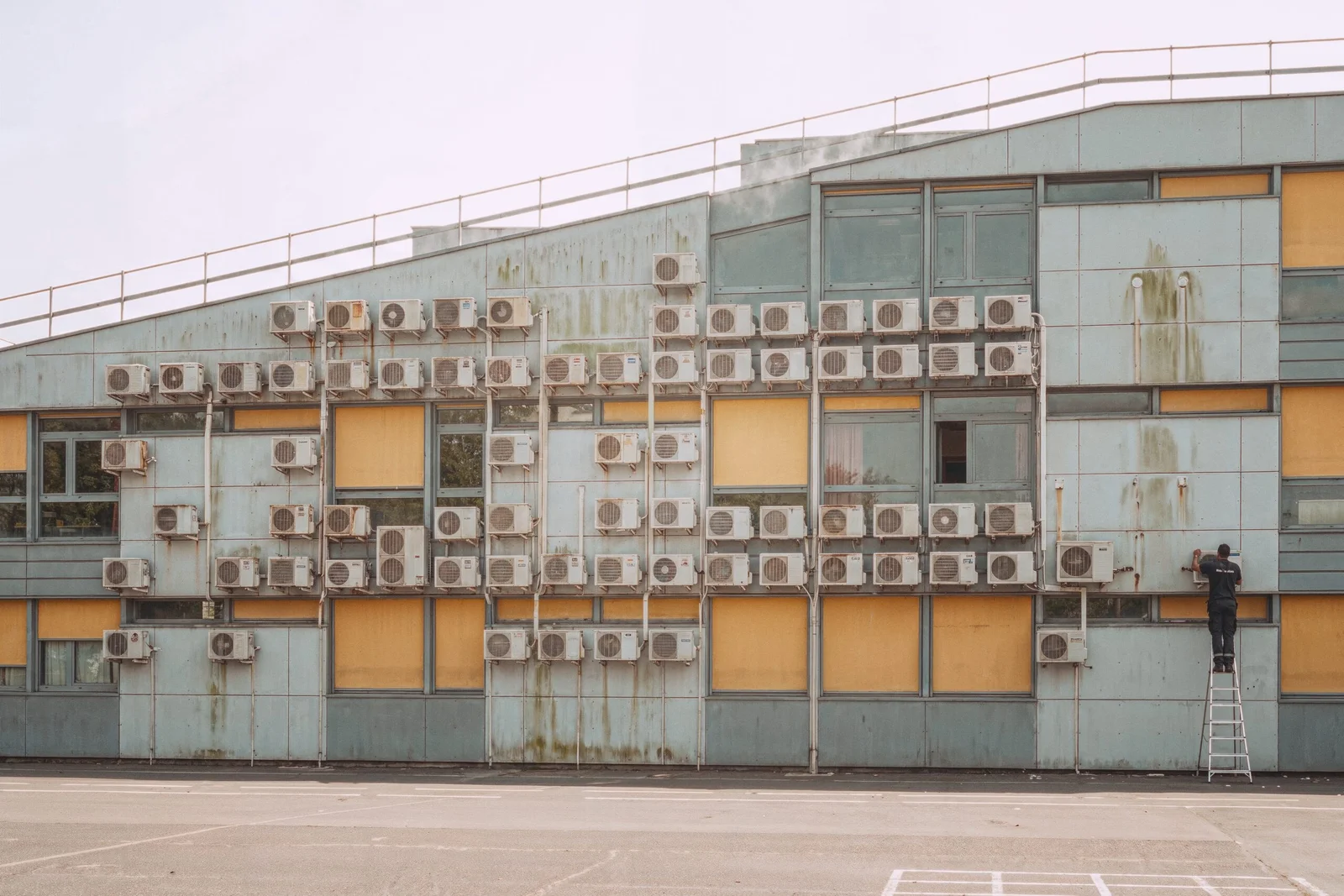
A hundred outdoor air-conditioning units set in an irregular archipelago across three storeys, each on its own sealed bracket, each of a different make and wear. A technician in overalls installs one more, at the top of a ladder. White heatwave sky, deserted car park.
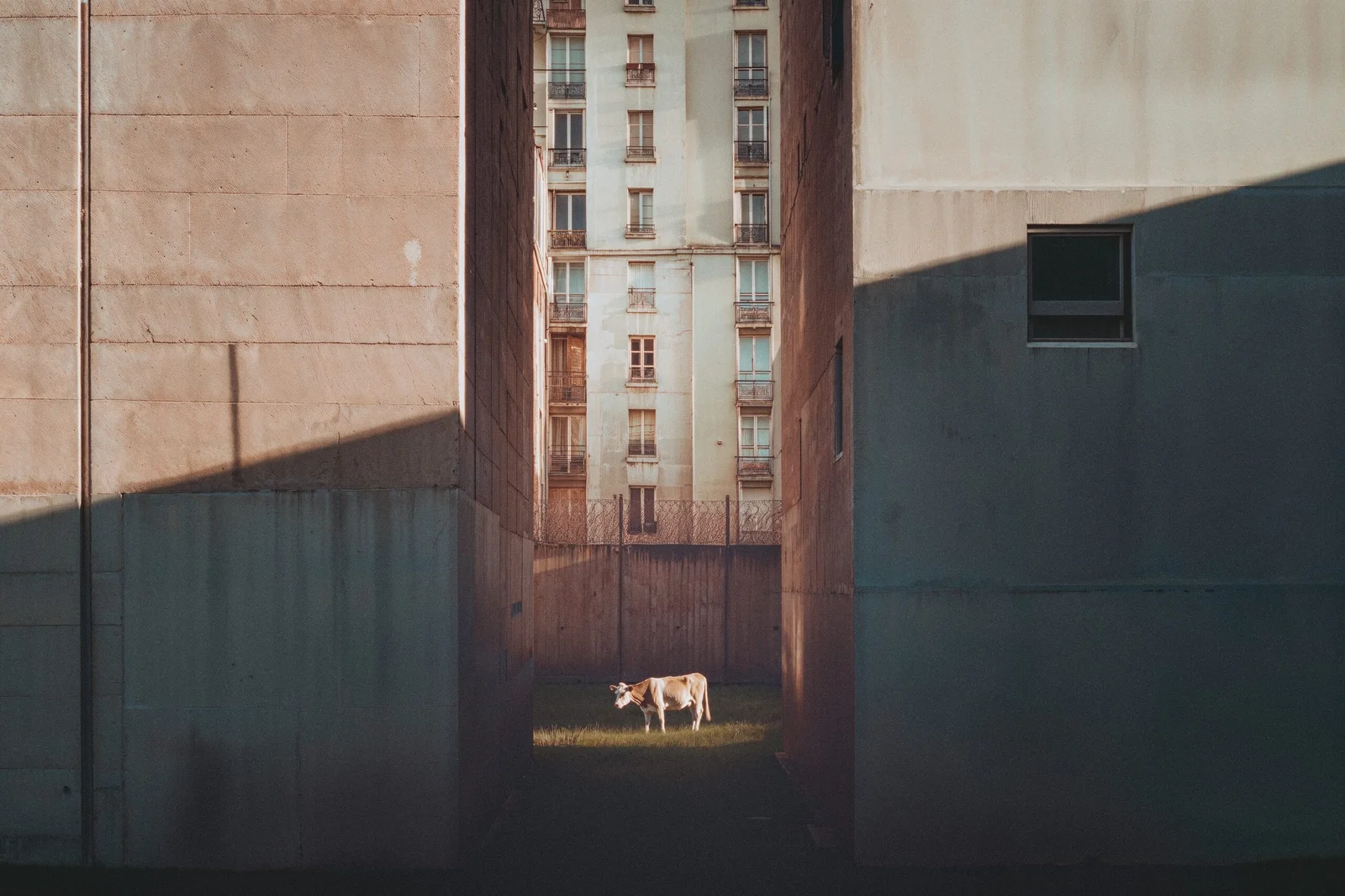
Two blind concrete walls frame a strip of grass lit by a shaft of sunlight; a cow grazes there. Behind, a façade with closed shutters.
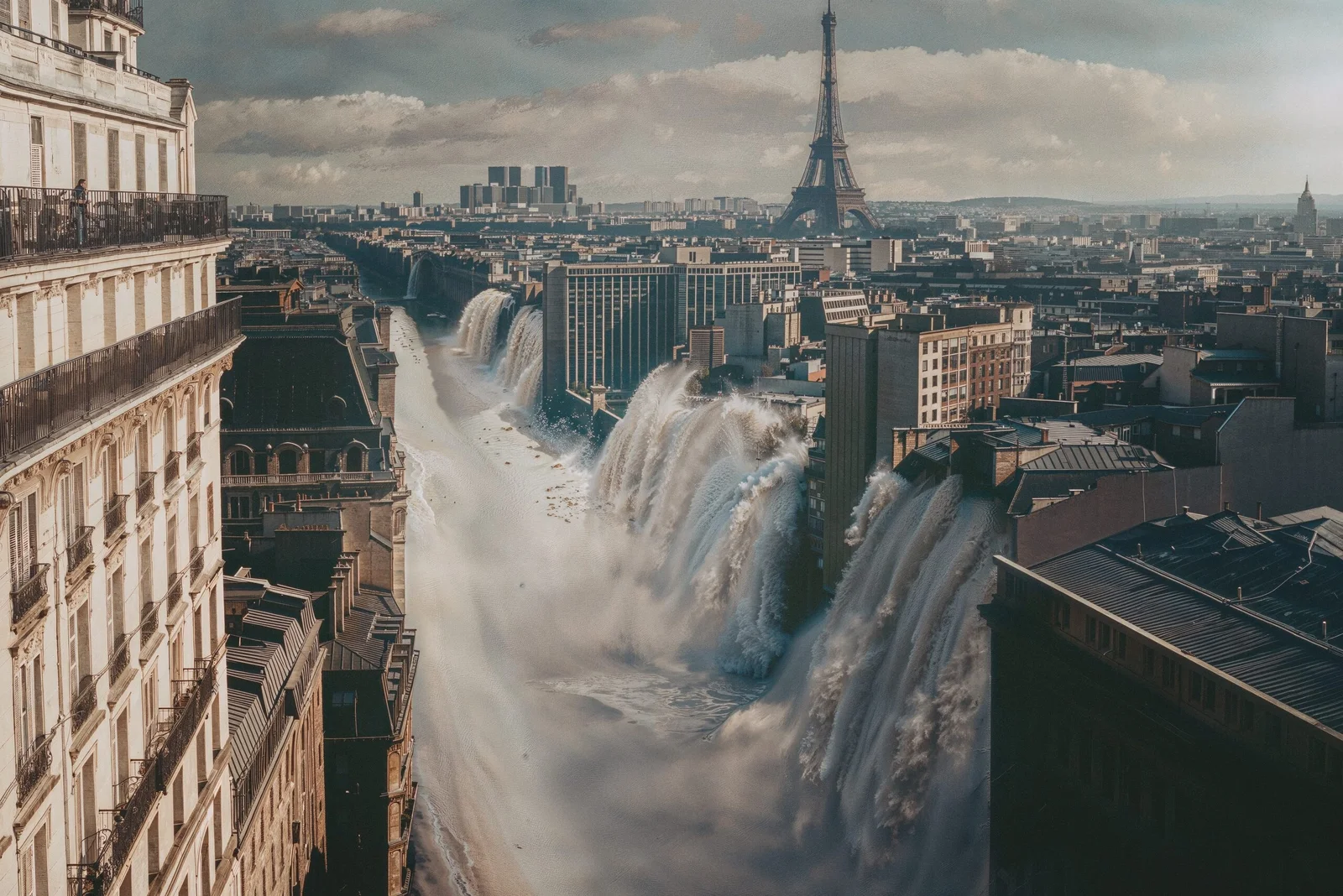
Seen from the rooftops: walls of white water hurtle down the avenues between the buildings. In the distance, the Parisian skyline intact under a serene sky.
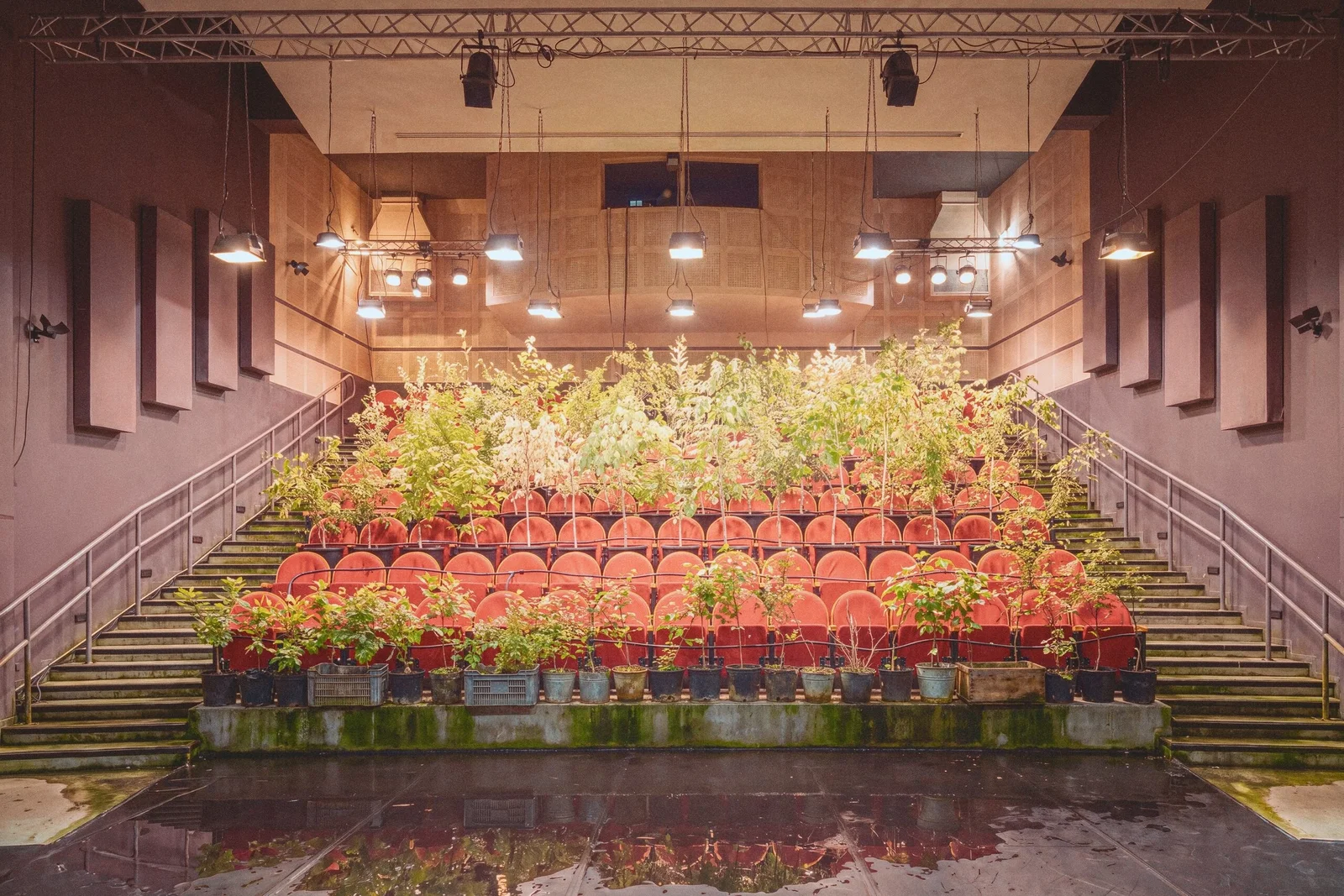
The hall has become the municipal tree nursery. Young oaks, hornbeams, wild cherries and maples occupy every step of the tiers, in mismatched pots and crates. The red seats were never removed. The stage lights have been replaced by grow lamps. The stage is a permanent mirror of water.
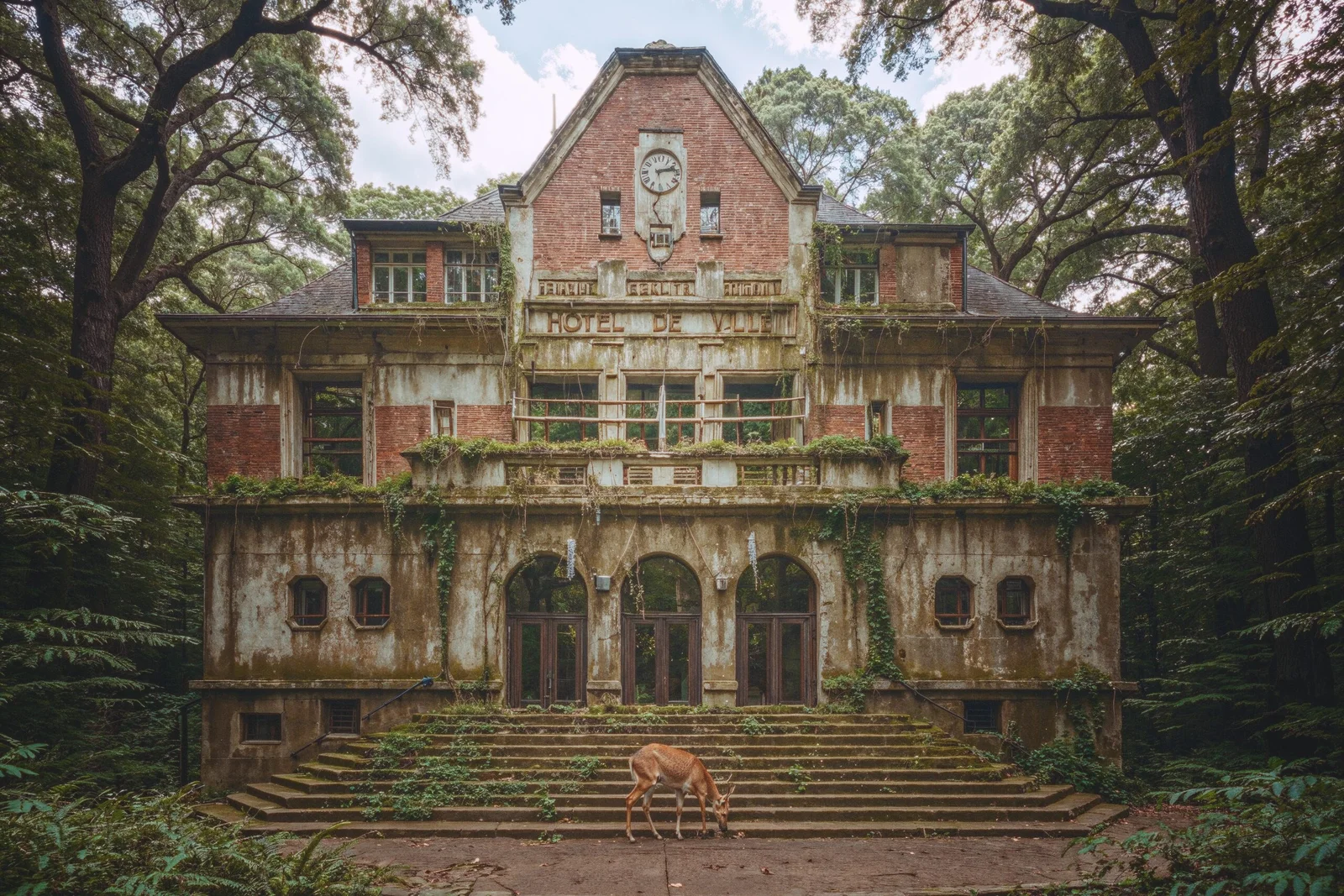
A frontal façade left to the vegetation: stopped clock, the pediment’s “LIBERTÉ ÉGALITÉ FRATERNITÉ” half worn away, ivy in cascades. A stag grazes on the steps. A stand of pines all around.
The moat is in active flood: water forced under the washhouse’s three arches, a churning centre, foam, debris carried off. A half-swamped boat strains at its mooring. A mass of branches is jammed against the wall — it says this has happened before.
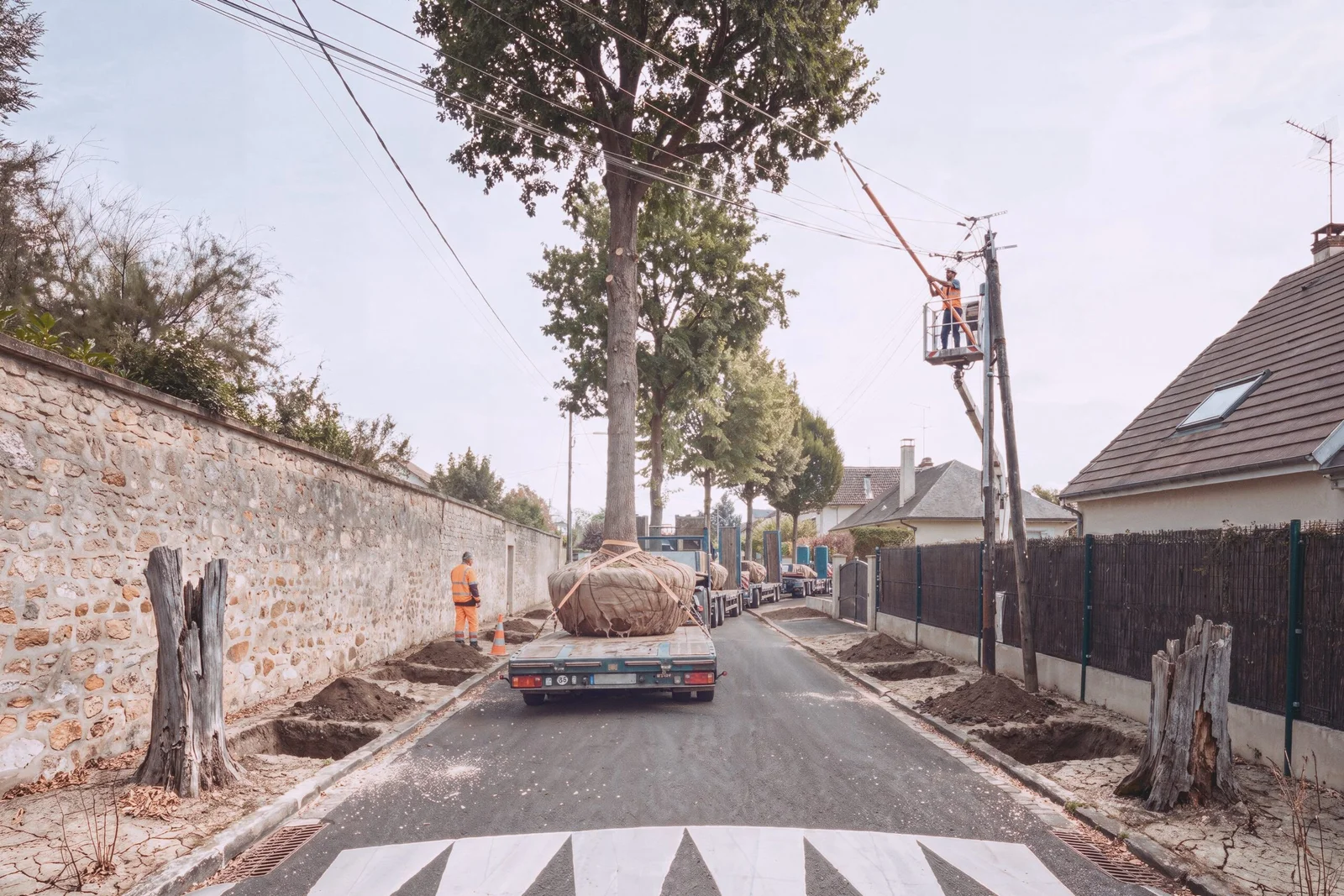
The street has been felled. In the middle of the road, at a standstill, a low-loader carries an adult oak upright, its jute root ball strapped in orange. Behind it, the queue continues. A worker on a lift clears the cables. The forest is coming back — but it comes back by lorry, one tree at a time, by appointment.
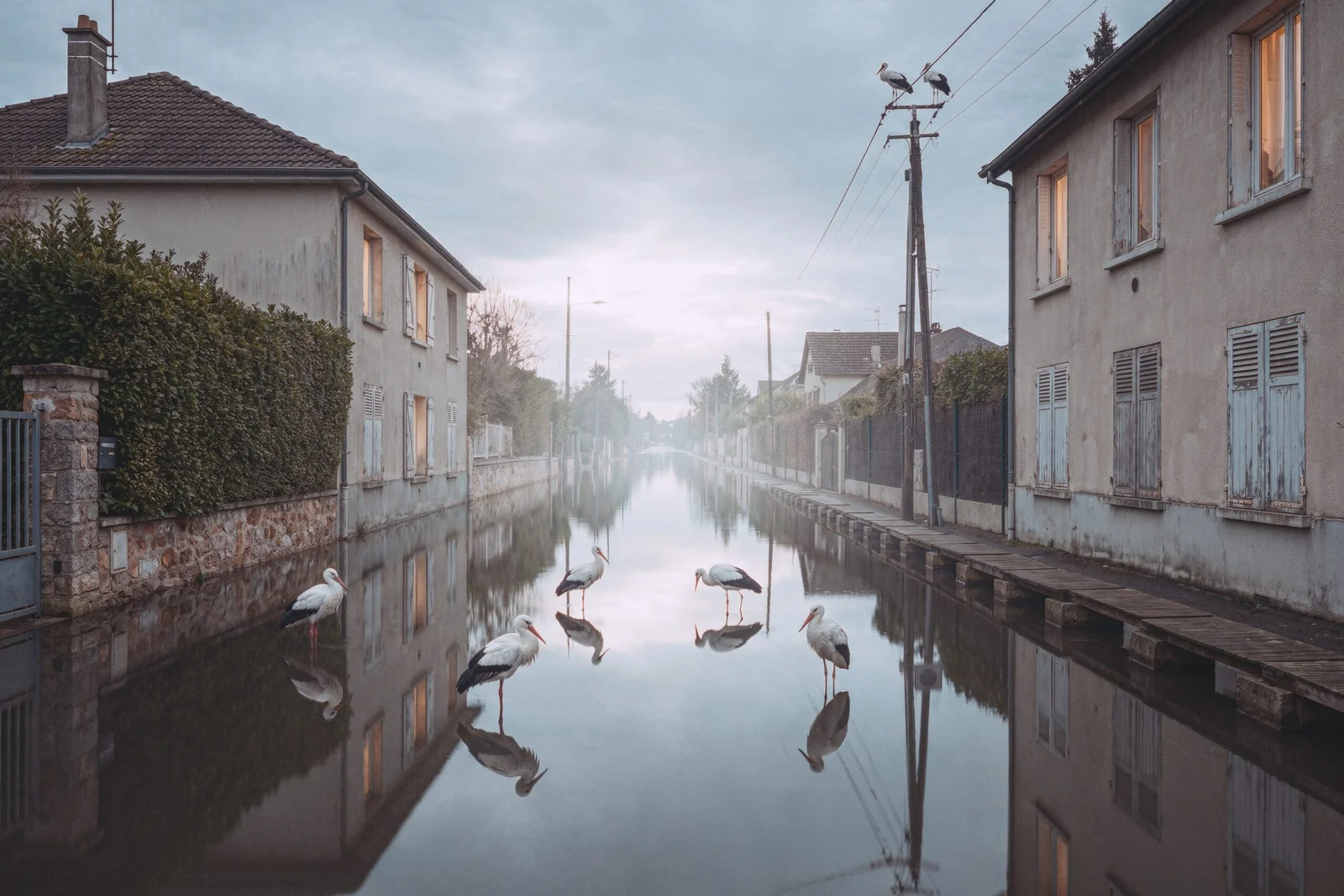
The road has become a still mirror of water. Five white storks wade in the street, two perch on the pole’s crossarm. Duckboards on blocks allow people to get around. Ground-floor shutters closed, upstairs windows lit, low mist.
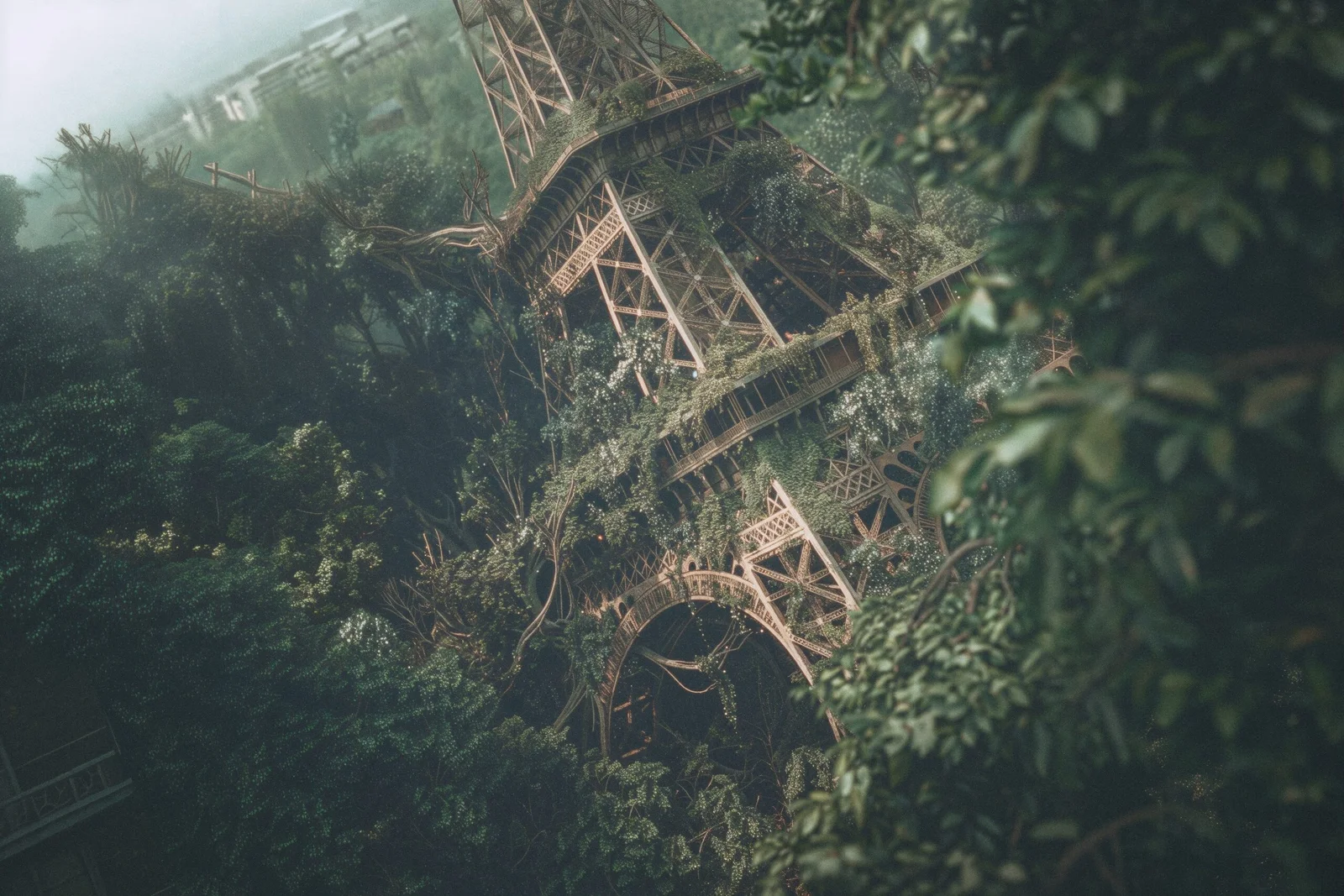
A plunging view, partly masked by foliage: the Eiffel Tower caught in a dense jungle climbing up to its platforms. Lianas on the cross-braces, diffuse green light.
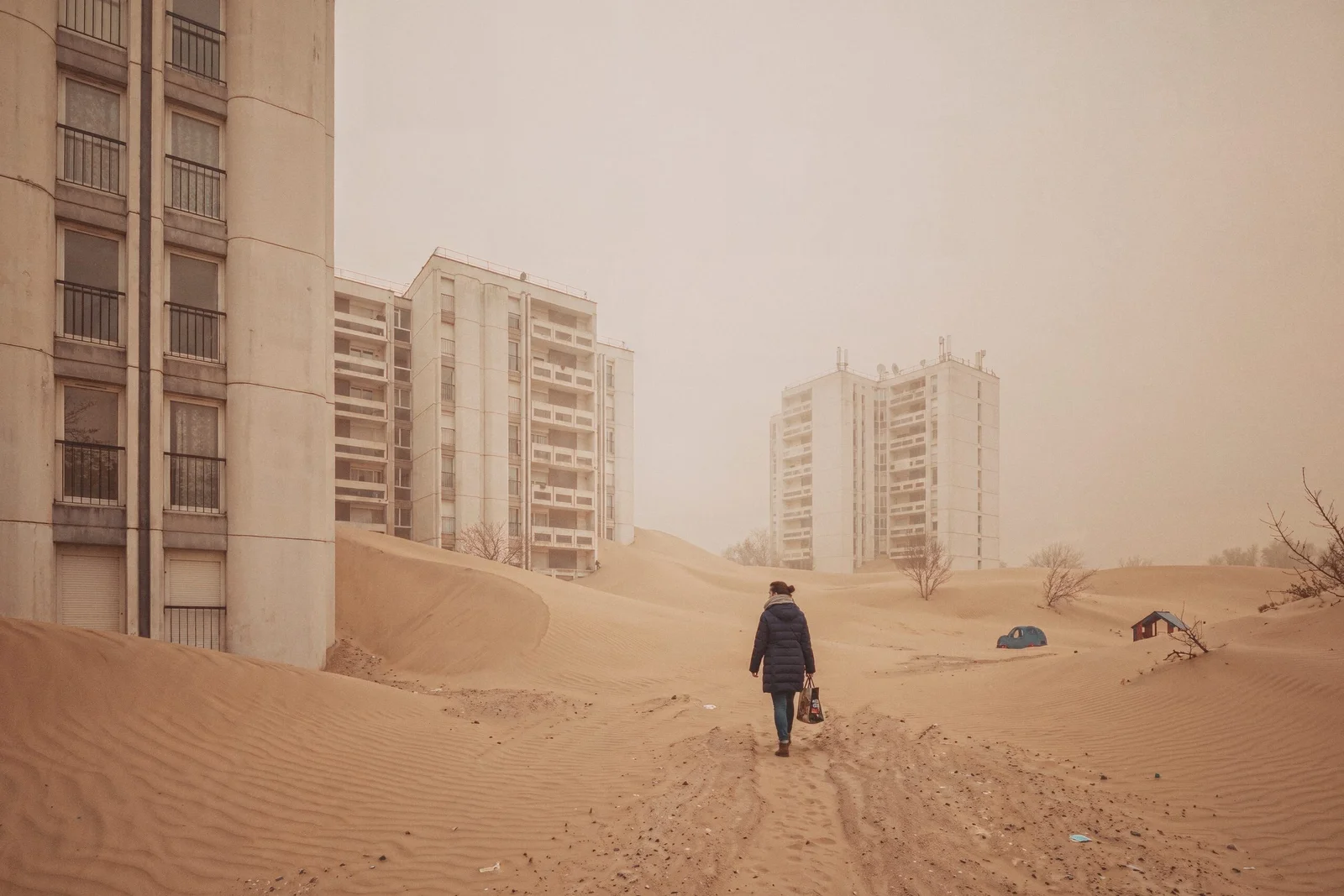
The ground has vanished under sand. Rippled dunes climb against the foot of the buildings and reach the ground floors. The playground lies beneath: the little blue car is buried to its wheel arches. A woman in a puffer jacket walks a path dug through the sand, shopping bag in hand.
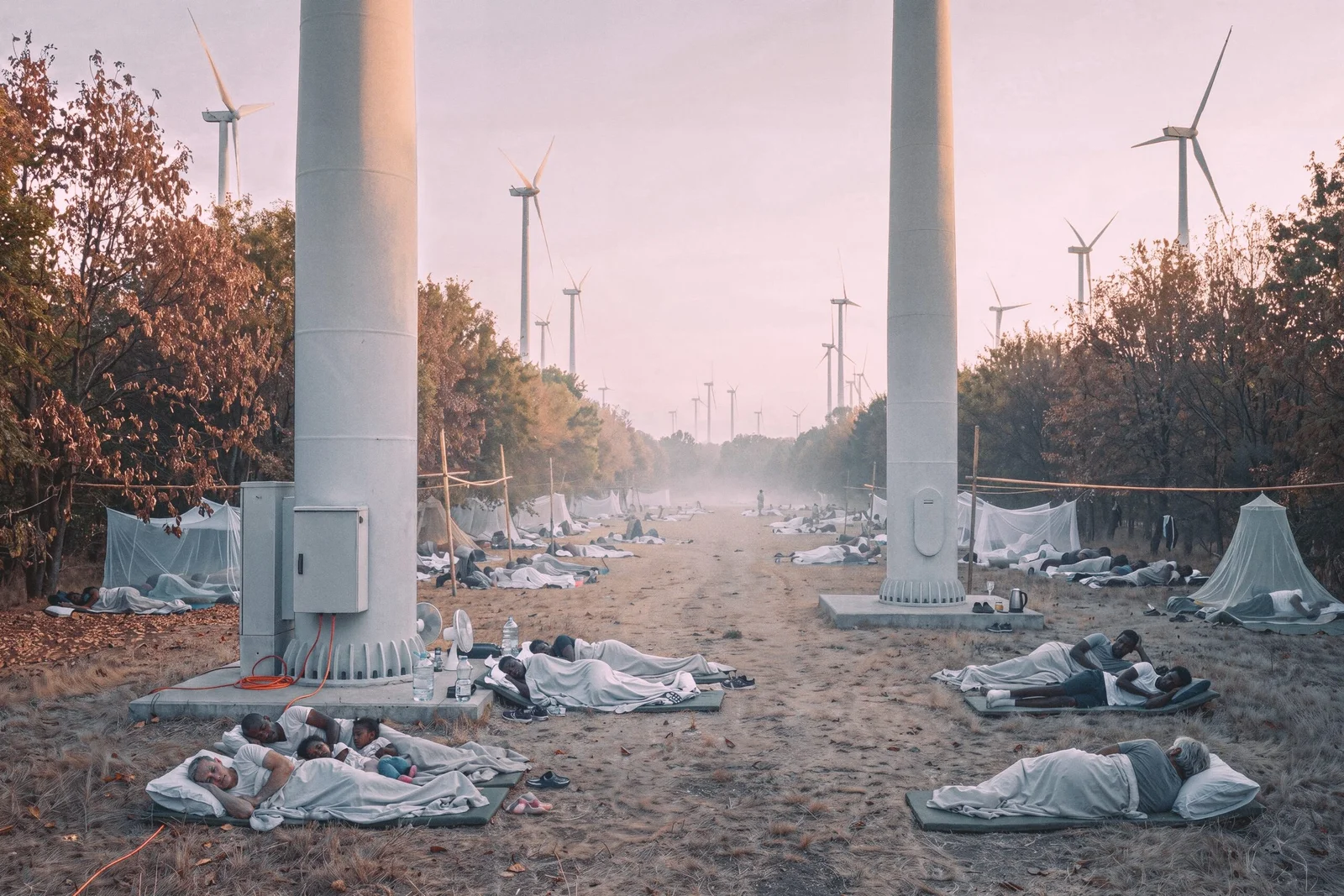
It was too hot to sleep indoors. Sixty or eighty people have spent the night on the lawn, in family clusters, under sheets and mosquito nets stretched on poles. It is half past five: the sun only reaches the treetops. Two wind-turbine towers rise out of the grass itself, among the mattresses.
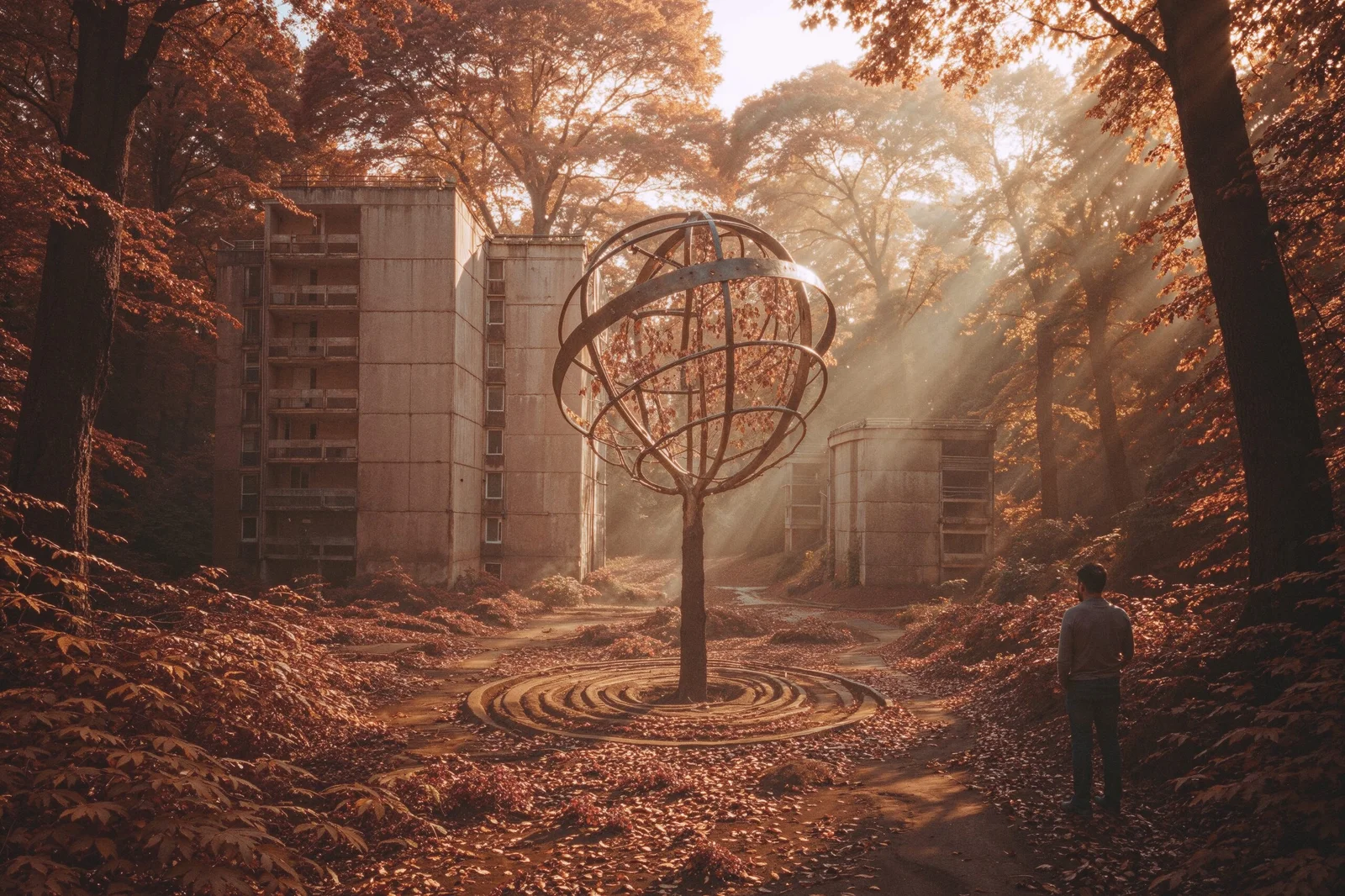
An autumn clearing, slanting rays in the mist. A monumental armillary sphere, rusted, planted at the centre of a circle of slabs. Behind: two empty housing blocks, swallowed by the forest. A man, seen from behind, watches.
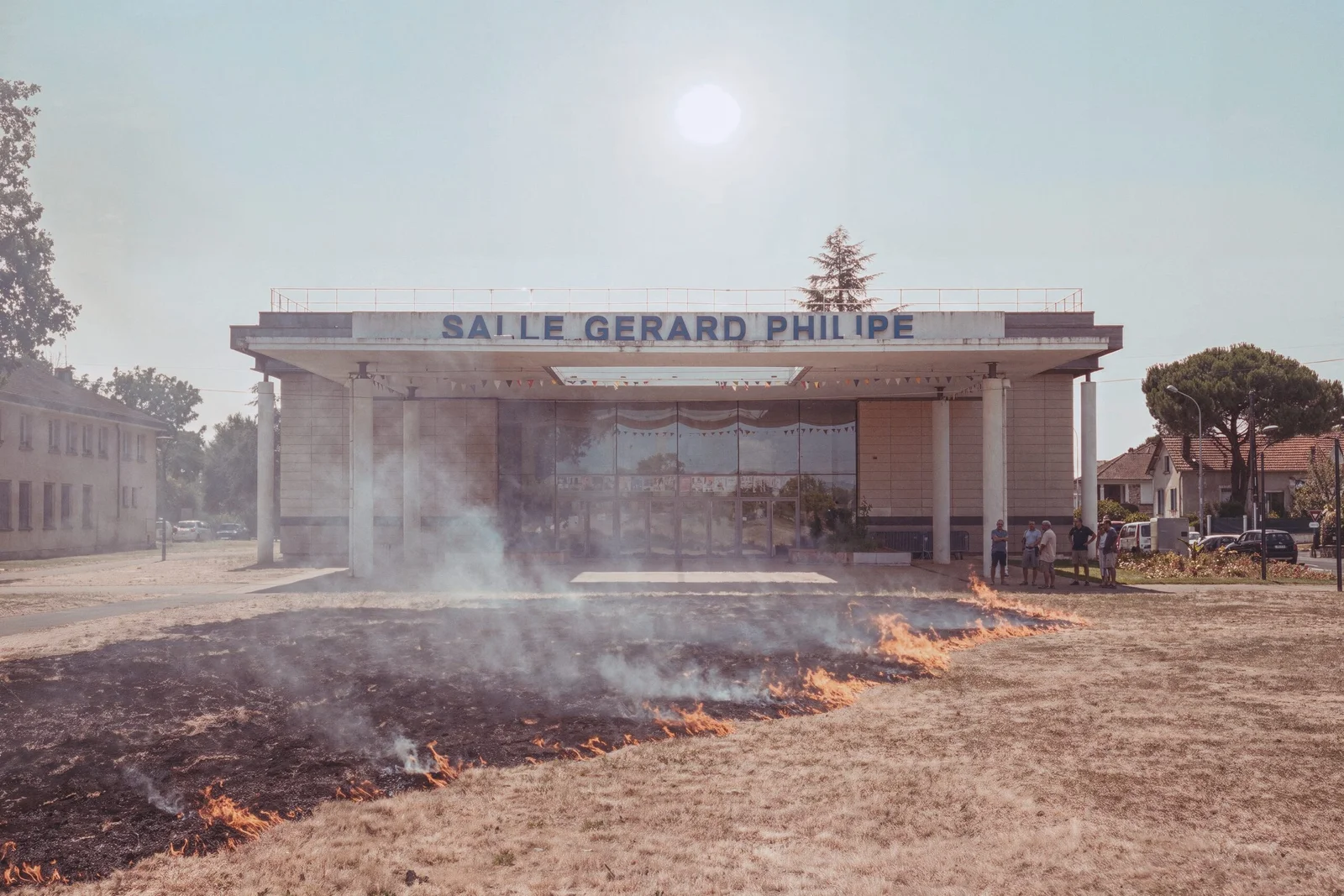
A low, continuous line of flame advances slowly across the already scorched lawn; behind it the grass is black and smoking, ahead of it, straw. The sun is a pale disc in the smoke. Five people standing on the forecourt watch without moving. The party bunting is intact under the awning.
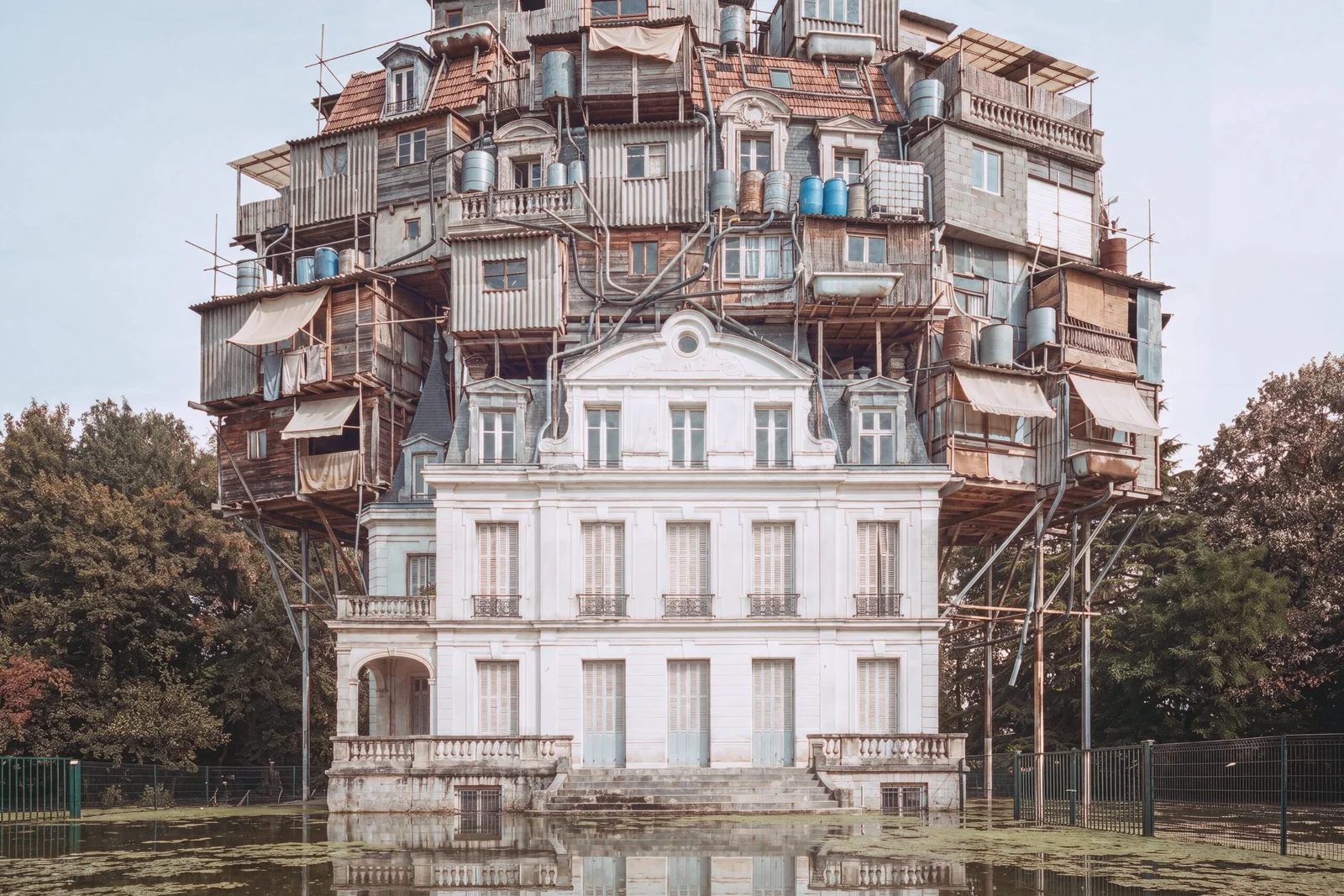
The château is intact, every shutter closed. Above its roof, eight or ten storeys of self-built structures have piled up, carried by slanting props and scaffolding tubes that reach down into the water. Thirty or forty tanks — galvanised cylinders, blue drums, caged cubes, bathtubs — occupy every ledge, linked by a tangle of pipes. The ground is drowned under green, stagnant water.
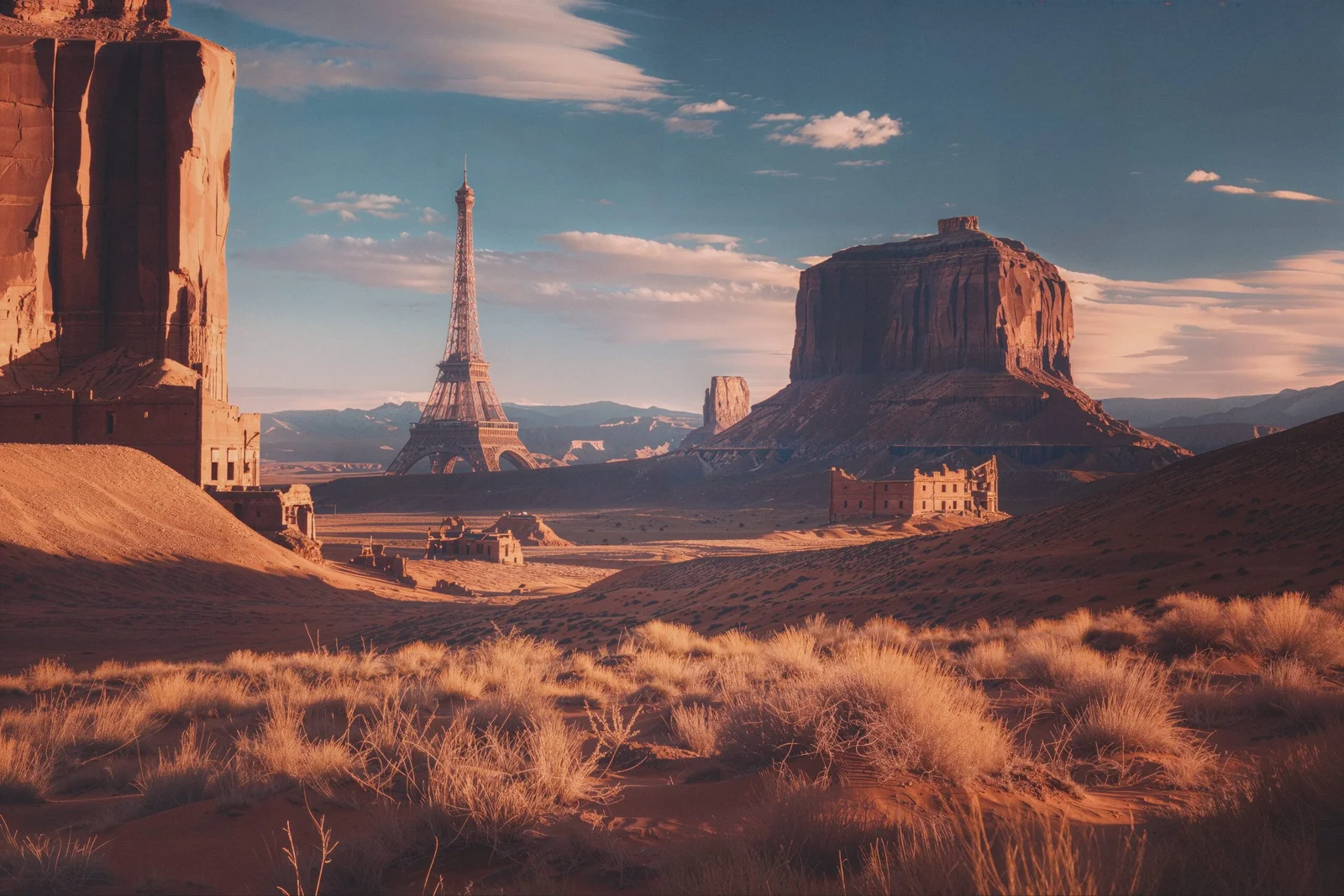
The Eiffel Tower standing among the mesas of Monument Valley, at dusk. Ruins of Haussmann buildings scattered through the dry grass. Low orange light.
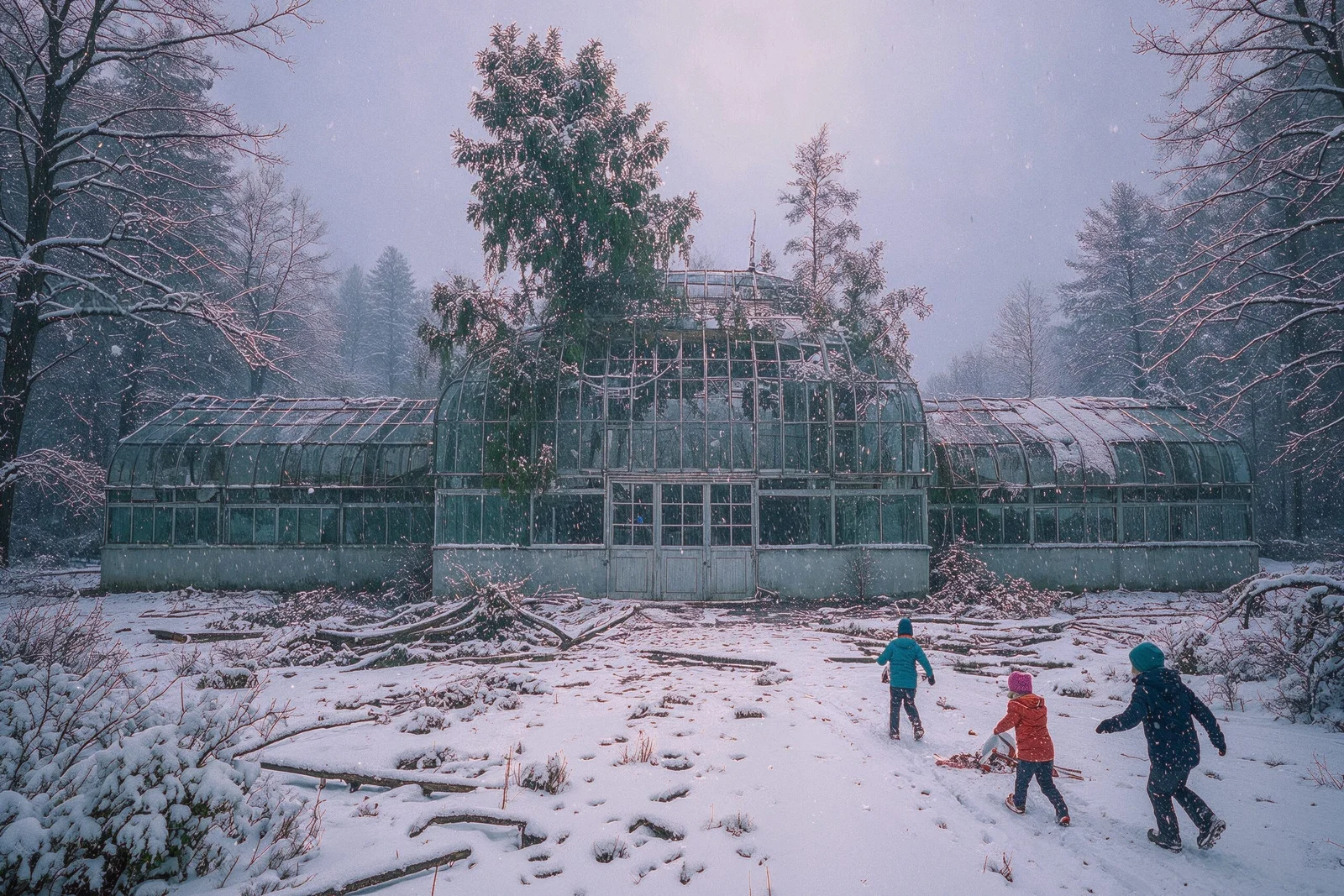
A large abandoned greenhouse, its glazing green and opaque, a fir tree having burst through the roof. Falling snow. Three children in bright puffer jackets run towards it, dragging a bundle of sticks.
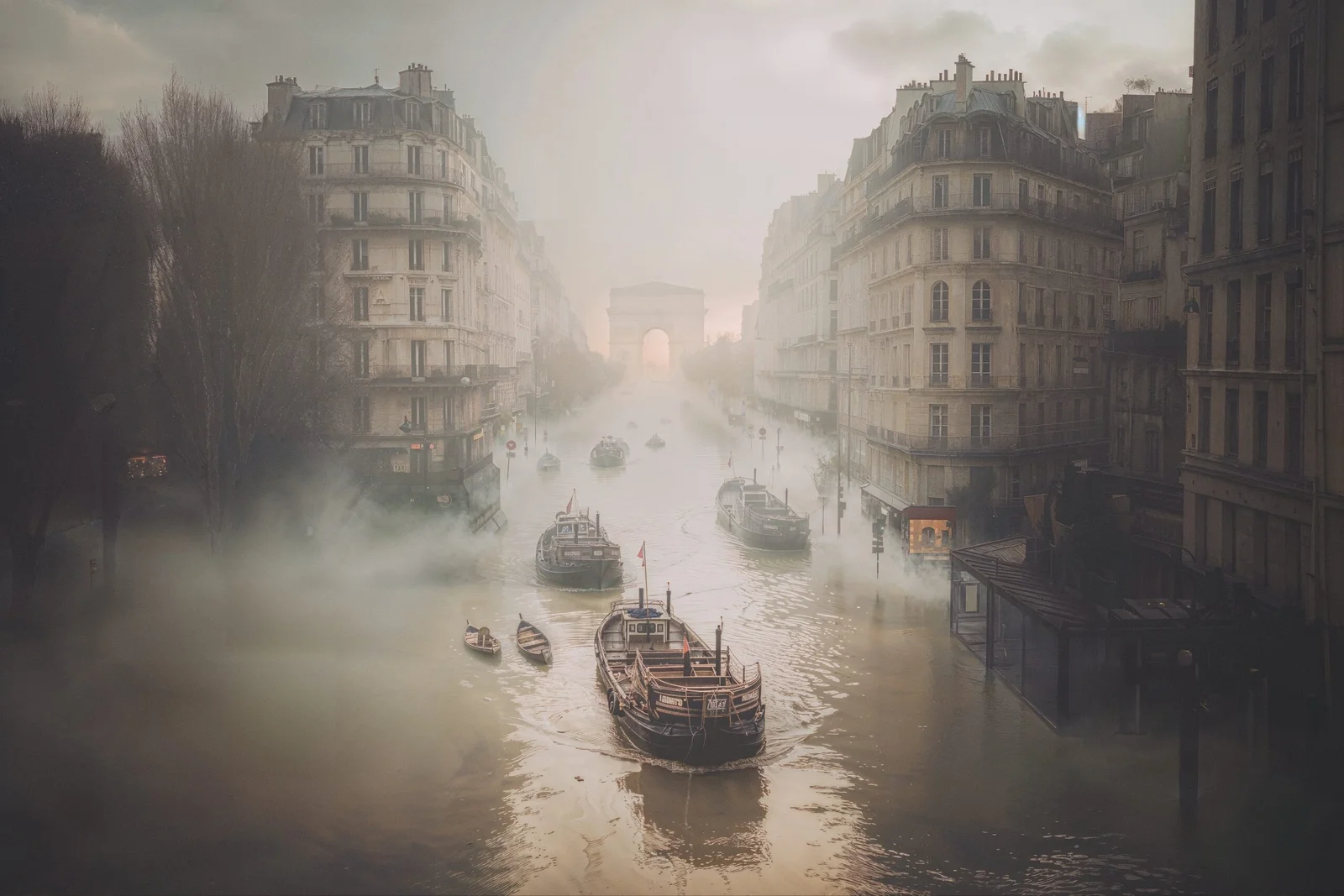
A Haussmann crossroads turned basin: five barges and two rowing boats sail there, low mist, the Porte Saint-Martin at the vanishing point in golden light. Silty water. Catastrophe here has already become everyday life.
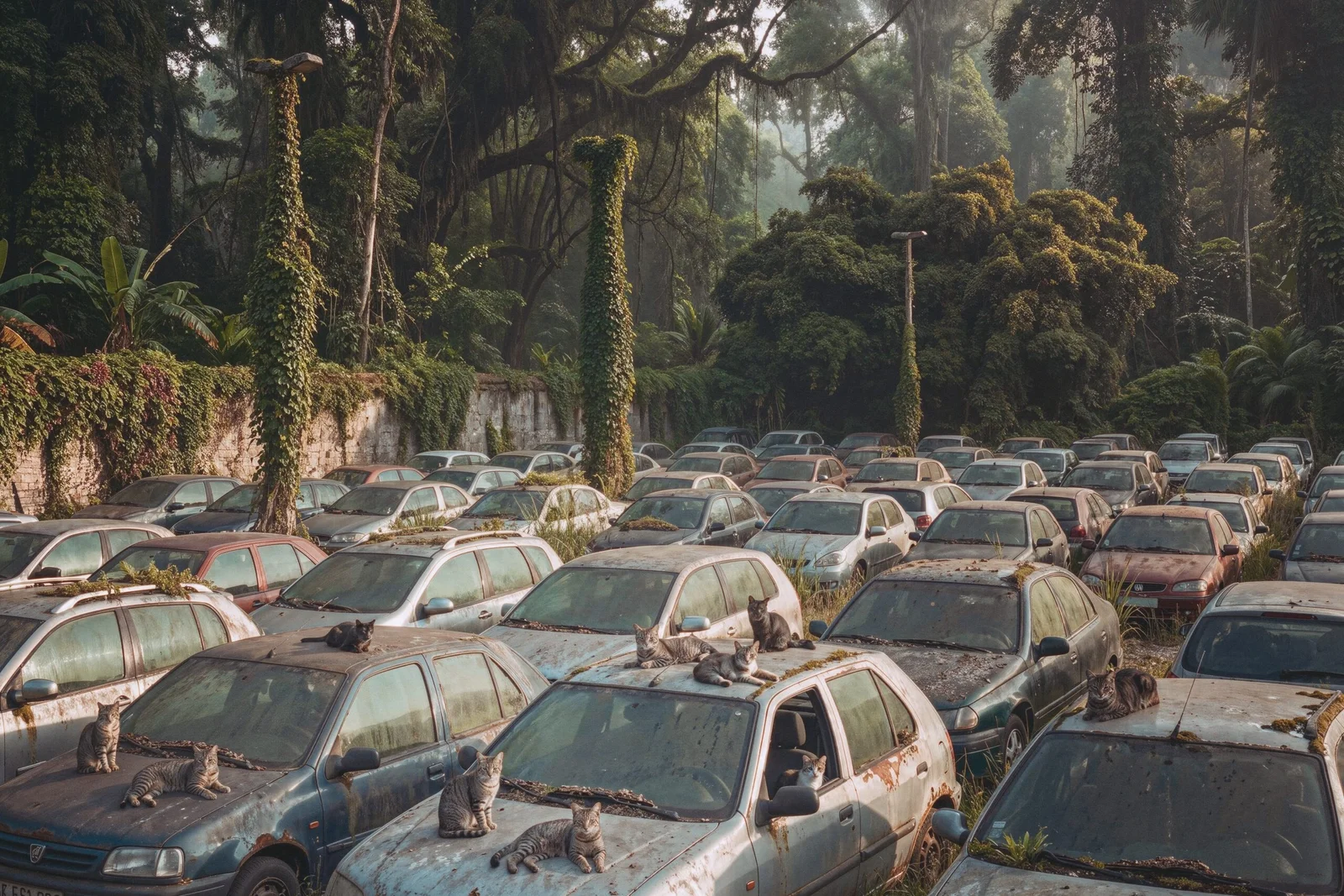
The wood has become a jungle, and it has come down into the car park. The cars are still parked in their bays, but they have been there for decades: moss and humus on the roofs, greened windscreens, flat tyres. The light masts have become columns of ivy. Some twenty feral cats occupy the bonnets in the foreground.
The reverse operation
Sainte-Geneviève-des-Bois was carved out of the forest between 1930 and 1960. This series shows the reverse operation.
The full approach, the short stories that accompany the works and the exhibition history are on the series page. For any question — visits, mediation, prints — write to me. The work can also be followed on Instagram.
Photographs and images: Pierre Châtel-Innocenti. Produced by the town of Sainte-Geneviève-des-Bois, cultural service.